Friday, May 13, 2011

Hell is Other Movies: Wrap Up Edition


Over the course of this past Metro Classics series, I watched a bunch of movies tangentially related to the films we were playing, with the idea of writing a little about them here the week the film's played.  Sometimes, I actually got those posts written.  These were the films I didn't get to.  A trio of Billy Wilder films for Double Indemnity, a Powell & Pressburger movie for A Matter of Life and Death, and a samurai movie for Seven Samurai.
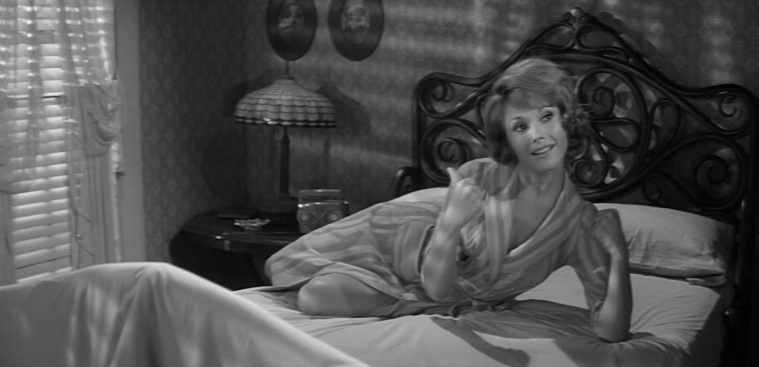

Kiss Me, Stupid - Possibly the strangest Billy Wilder film I've ever seen.  Ray Walston stars in an initially annoying performance (like always with comedies from this era, I kept thinking Jack Lemmon would have played the role better) as a small town piano teacher and aspiring songwriter.  When Dean Martin, in a vicious self-parody as popular womanizing drunk singer "Deano" rolls into town, Walston's writing partner, the local gas station attendant, schemes to get Deano to stay in town for the night, wherein Walston will convince him to listen to one of their songs and eventually make them big stars.  As Deano bait, they hire local cocktail waitress/prostitute Kim Novak to pose as Walston's wife and sleep with Deano, leaving Walston's actual wife, the adorable Felicia Farr none the wiser.  The first half of the film suffers through all this plot, and Walston's manic overplaying doesn't help at all.  But as the night grows late, the film shifts point of view from Walston's pathetic ambition and Deano's single-minded selfishness to Novak's melancholy resignation and Farr's dawning understanding of just what her husband has been up to.  It leads to an ending that's as close as the generally cynical and misanthropic Wilder ever got to transcendence.  


Five Graves to Cairo - On the other end of Wilder's career is this fine World War II drama starring Franchot Tone as a British officer in North Africa.  After barely surviving a German attack, he crawls to a bombed out hotel just before the German Army arrives and sets up a command post.  The hotel's owner (Touch of Evil's Akim Tamiroff) disguises him as the hotel's dead waiter, not knowing that the waiter was actually a German spy.  Tone poses as the spy in order to learn Rommel's plans for the invasion of Egypt.  With Anne Baxter (All About Eve) as the hotel maid who hates and then loves Tone and Erich von Stroheim as Rommel.  It's a great example of the war movie genre, with excellent performances, efficient story-telling and the same toughness Wilder would later bring to his noirs.  Franchot Tone is an actor I'm starting to really like, he's got a great voice and he always looks angry. 


Avanti! - One of Wilder's last films stars Jack Lemmon as a wealthy businessman who travels to Italy to pick up his father's dead body.  While there, he discovers his father had been having a decades-long affair with an English woman when he meets her flighty daughter (Juliet Mills), in town to pick up her mother's body.  He might be Lemmon's most unpleasant character, kind of like his award-winning performance a year later in Save the Tiger, but with less self-pity, and the film is essentially a manic-pixie narrative, with Mills and Italy conspiring to turn Lemmon into a decent human being.  I don't think it really earns Lemmon's redemption, but it might be Wilder's most beautiful film.  Italy seems to have softened Wilder a bit, as we get great shots of the countryside and the ocean and a beautiful sequence in a mortuary, golden sunlight streaming through a lone window into a room empty but for the coffins and a bureaucrat's table. 


The Battle of the River Plate - One of the last collaborations between Michael Powell & Emeric Pressburger is a bit of an oddity.  It's an apparently real account of a true story, where in the early days of World War 2, the German pocket battleship Graf Spee, after harassing Allied shipping off South America for months, is cornered at the mouth of the River Plate, off the coast of Montevideo, Ecuador.  The bulk of the film is taken up with the question of what will happen next: the Germans requesting permission to conduct repairs in the hope that reinforcements will arrive, the Allies trying to lure her out and sink her before that can happen.  The story is mostly told from the perspective of the Allied officers captured by the Graf Spee and what they can piece together from inside the ship, and later from a radio news broadcaster, sending out updates worldwide from a seafront bar.  For a war movie, there's hardly any action, and the scope of the film limits the kind of character examinations Powell & Pressburger were so good at.  Most notably absent, though, is the kind of uncanny spirituality that seems to emanate from the earth itself in their greatest films, where the characters are taken over by their environments and radically transformed.  Maybe because so much of it takes place at sea?  


Onibaba - A medieval horror film from director Kaneto Shindo about a woman and her daughter-in-law during war-torn 1300s Japan.  In order to survive, the two hunt down wounded and dying samurai fleeing the local battles, murder them and trade their weapons and armor for meager amounts of millet and rice.  When a neighbor returns home, after fleeing the fighting himself, he begins a clandestine affair with the daughter-in-law (her husband, he claims, is dead).  The old woman contrives a plan to keep them apart using a terrifying mask she's taken from a murdered samurai, which of course only makes things much, much worse.  A harrowing look at medieval life, unusual in its focus on women and the poor for a samurai film, the film makes excellent use of its location on a sluggish riverside in a field of giant grass, and Shindo uses every trick in the expressionist playbook to make a very scary film out of a samurai film-critiquing Buddhist parable about interfering in young people's love lives.  It's reminiscent of another film released the same year, Hiroshi Teshigahara's The Woman of the Dunes, but where that film is all mysterious, dreamy romanticism, this one is shock effects and misery. 

Sunday, May 1, 2011

Critics Agree Part VII: The Hollow Death


Pundits periodically pontificate on the perennial prospect of film criticism perishing.  These high-falutin' fools certainly have not scoured the pages of Netflix where intellectual rigor and thoughtful analysis lay there for the taking.

Charade-


"My apple was set at the loudest volume setting but I could barely hear. Therefore I stopped watching" --1 star


F for Fake-


"I want to punch all the people who made glowing reviews about this garbage. I rented it because I thought it was a documentary. Pay zero attention to what the description says because it's a complete lie. What you get is some artsy crappy film where Orson is just talking. He talks over every thing. It's all about Orson sitting with a drink and blabbering on. There's zero movie in this. The footage is naturally very old but it's all shaky and terrible looking. My breaking point came when Orson was reading poetry for no reason while crazy music played and things were on fire. Absolutely the most horrible film of any kind that I've ever seen." --1 star


All About Eve-


"Frankly, the starting scene of this movie was so boring and uninteresting that it moved me to turn the whole CD off. I like theater plays, but I couldn't care less about theater performers' problems. Maybe I should have been more patient." --2 stars

"Very boring! The story was vague and the characters uninteresting. Nothing really happens. A scene in which Marilyn Monroe is sitting on the stairs chatting with a group of people at a cocktail party was the only worthwhile part. We quit watching halfway through. Don't waste your time on this one." --1 star

The Adventures of Robin Hood-


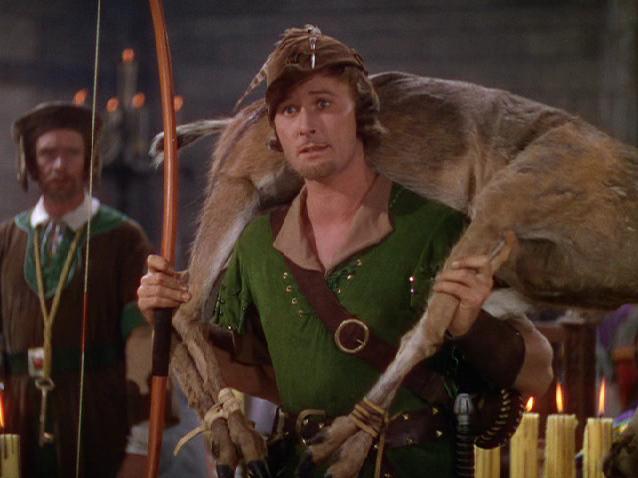
"Our family just loved this movie! Lots of excitement, adventure and laughs. Would recommend highly." --2 stars


The Sting-


"I am not a fan of ragtime mnusic nor of films involving gambling. Therefore I did not watch this movie, only the first 20 minutes or so. Did not appeal to me." --2 stars

"Ok, so I watched the Sting. Part of me wanted to turn it off so I did. A few days later I finished it. If you need to fall asleep, put this movie on. So overrated-" --1 star


The Wild Bunch-


"I watched 28 minutes of it and got bored to death. Acting was terrible and the violence just a 1960,s spaghetti western yawn. Dont waste your time. Whoever compared this to even the worst Clint Eastwood flick must be on drugs." --1 star

"It would be nice to see a preview of a movie that you are interested in.But for months now I been writing in regard to this and no one replys. Does anyone get to watch a preview before they rent a movie? Please let me know.Thank you xfiles535@aol.com" --5 stars


L'Avventura-


"What adventure? Our Greater Swiss Mountain dog, Oscar, has more adventures sniffing out deer and chasing squirrels." --2 stars

"Sorry. After the island scenes, this movie was so profoundly boring it almost had me wishing for Transformers." --1 star

"why did this film win so many awards?? i have no idea.. it was slow-moving and boring. Theyre supose to be looking for their missing friend and they just kind of forget about her and hook-up with each other instead... hos." --1 star


Unfaithfully Yours-


"If only the main character wasn't a total jerk, or maybe if the plot wasn't telegraphed from the start, or maybe if the comedy was funny instead of slow-motion slapstick... Maybe I should have liked this movie. It had period charm and black & white drama. But ultimately it was boring." --2 stars


Crimes and Misdemeanors-


"Disc arrived cracked, never received a replacement ( 5 days of mem=bership wasted )" --5 stars

Thursday, April 28, 2011

So Long to Hell


Thanks to everyone who came out this Spring and helped make Metro Classics Goes to Hell one of our most successful series since we started five years ago.

We're off to Purgatory for a few months, but we'll be returning in August for another 18 weeks of Metro Classics goodness.  Stay tuned here for updates and the occasional random post about movies we probably won't play.  You can also follow us on the facebook.

Monday, April 25, 2011

Top 5 Top 5 Lists Related To, But Not Including, Mr. Smith Goes to Washington


Top 5 Frank Capra Films:

1. It's a Wonderful Life (1946)
2. The Bitter Tea of General Yen (1933)
3. It Happened One Night (1934)
4. Arsenic & Old Lace (1944)
5. Meet John Doe (1941)


Top 5 Jean Arthur Films:

1. Only Angels Have Wings (Howard Hawks, 1939)
2. Easy Living (Mitchell Leisen, 1937)
3. The More the Merrier (George Stevens, 1943)
4. Shane (George Stevens, 1953)
5. Mr. Deeds Goes to Town (Frank Capra, 1936)


Top 5 Thomas Mitchell Films:

1. Make Way for Tomorrow (Leo McCarey, 1937)
2. Stagecoach (John Ford, 1939)
3. It's a Wonderful Life (Frank Capra, 1946)
4. Gone with the Wind (Victor Fleming, 1939)
5. Only Angels Have Wings (Howard Hawks, 1939)


Top 5 Harry Carey Films:

1. Red River (Howard Hawks, 1948)
2. The Musketeers of Pig Alley (DW Griffith, 1912)
3. Air Force (Howard Hawks, 1943)
4. Duel in the Sun (King Vidor, 1946)
5. Barbary Coast (Howard Hawks, 1935)


Top 5 Films of 1939:

1. The Rules of the Game (Jean Renoir)
2. Stagecoach (John Ford)
3. Gone with the Wind (Victor Fleming(
4. Only Angels Have Wings (Howard Hawks)
5. Young Mr. Lincoln (John Ford)

Friday, April 22, 2011

Links: Mr. Smith Goes to Washington


Otis Ferguson, one of America's first great film critics, was not a fan of Mr. Smith Goes to Washington on its release back in 1939, accusing director Frank Capra in The New Republic of putting ideas before people, and of having crowd-pleasing ideas among them:

"Frank Capra’s “Mr. Smith Goes to Washington” is going to be the big movie explosion of the year, and reviewers are going to think twice and think sourly before they’ll want to put it down for the clumsy and irritating thing it is. It is a mixture of tough, factual patter about congressional cloakrooms and pressure groups, and a naïve but shameless hooraw for the American relic—Parson Weems at a flag-raising."


Frank S. Nugent, no slouch of a critic himself (and the screenwriter of Classics The Searchers and The Quiet Man, among other films), disagreed in the New York Times, noting that Capra succeeds not just in walking the line between comedy and drama, but between condemnation and celebration of the American government:

"For Mr. Capra is a believer in democracy as well as a stout-hearted humorist. Although he is subjecting the Capitol's bill-collectors to a deal of quizzing and to a scrutiny which is not always tender, he still regards them with affection and hope as the implements, however imperfect they may be, of our kind of government. Most directors would not have attempted to express that faith otherwise than in terms of drama or melodrama. Capra, like the juggler who performed at the Virgin's shrine, has had to employ the only medium he knows. And his comedy has become, in consequence, not merely a brilliant jest, but a stirring and even inspiring testament to liberty and freedom, to simplicity and honesty and to the innate dignity of just the average man."


Some enterprising individual at the University of Virginia has collected a number of other contemporary reviews of Mr. Smith, highlighting the various contemporary reactions to the film.  Of particular interest, considering the film's rah-rah rep, are these reported in The Christian Science Monitor:

Senator Alban W. Barkely (D-Kentucky):  "He declared he spoke not only for himself but for the entire Senate in his condemnation. The picture, he declared, was a "grotesque distortion" of the way the Senate is run.... "As grotesque as anything I have ever seen! Imagine the Vice President of the United States winking at a pretty girl in the gallery in order to encourage a filibuster! Can you visualize Jack Garner winking up at Hedy Lamarr in order to egg her on?""

Senator James F. Byrnes (D-South Carolina): "outrageous . . . exactly the kind of picture that dictators of totalitarian governments would like to have their subjects believe exists in a democracy...."

And from The Hollywood Reporter in 1942 on Mr. Smith being the last American film to play in France before the Nazi Occupation cut off distribution:


"Similarly cheers and acclamation punctuated the famous speech of the young senator on man's rights and dignity. "It was," writes the Nachrichten's correspondent, "as though the joys, suffering, love and hatred, the hopes and wishes of an entire people who value freedom above everything, found expression for the last time . . ."

Amplifying on this defiance of Nazi oppression, the Army News Service sent me word that one theater in a French village in the Vosges Mountains played Mr. Smith continuously during the last thirty days before the ban."

Thursday, April 21, 2011

Coming Attractions: Mr Smith Goes to Washington


Wednesday, 27 April at 6:45 & 9:15 P.M.

Giveaways: Destry Rides Again DVD courtesy of Scarecrow Video, and a gift certificate to Cinema Books, respectively.

The circle is complete.