After finishing his series of Six Moral Tales (of which this week's classic,
My Night at Maud's is the third) with 1972's
Love in the Afternoon, Eric Rohmer spent the rest of the 1970s working in television and making a pair of period films,
The Marquise of O and
Perceval le Gallois. In 1981, he began a new series of six films he called Comedies and Proverbs, each starting with a famous saying ("It is impossible to think about nothing." "He who talks too much will hurt himself." and so on). Like the Moral Tales, the films revolve around the twin poles of romantic relationships and vacation. In each of the films one of the main characters is driven by an ideal (usually of a potential lover, but not always) and has that ideal frustrated. Unlike the Moral Tales, most of the protagonists are women, and we get a much more balanced view of gender dynamics than in that earlier series. Like every Rohmer movie, the films are dominated by conversation and are beautifully shot in a style that rarely calls attention to itself. Every time I think about watching one of his movies, I kind of dread it (Do I really want to watch 90 minutes of French people talking? Doesn't that sound like the most boring thing in the world?). But every time I find myself entertained throughout, enraptured even. I don't exactly know how he does it, his movies sneak in and surprise me every time. In 14 films, I've never once been bored by Eric Rohmer.
 The Aviator's Wife
 - A young man, a law student, sees an older man leaving his (the student's) older girlfriend's apartment early in the morning. The man was her ex-boyfriend, and he had been there to end their relationship because he was re-committing to his wife. The student confronts the girl, but she denies everything and gets annoyed. Later in the day, the student spots the older man and decides to follow him (he's especially suspicious when he sees the man with a mysterious blonde woman). In a park, he meets a younger girl who decides to help him in his caper. The film comes alive when the younger girl, played by Anne-Laure Meury (who has a supporting role in
My Boyfriend's Girlfriend), appears. She's clearly much more interesting and a much better fit for the student than the older woman, but he doesn't notice. The location for the middle section of the film, a man-made park in Paris, is used wonderfully, and Meury and the student's adventures creating plotlines for the behavior of the older man and the blonde woman harken back to the kinds of protagonists that reinvent Paris in cinematic and narrative terms, a New Wave trope familiar from the likes of
Celine & Julie Go Boating and
Band of Outsiders, among many others. This is the only one of the Comedies and Proverbs wherein the main character is a man, and as a fairly deluded one, he serves as a nice transition between the aggressively masculine (though of course quite talky and usually deluded) heroes of the Moral Tales.
 A Good Marriage
 - A young art history student (Béatrice Romand) breaks up with her painter boyfriend and moves back home to her small town (Le Mans) where she meets a cousin of her best friend and decides to marry him. Unfortunately for her, the young man doesn't ever seem to have enough free time to fall in love with her as well. The man is played by André Dussollier, familiar, though looking much much younger, from last year's releases
Wild Grass and
Micmacs, directed by Alain Resnais and Jean-Pierre Jeunet, respectively. It's a film where quite literally nothing happens, all of the students schemes end in failure, but is nonetheless so full of beautiful little heart-breaking moments as to always be compelling (Romand putting her head on Dussolier's shoulder as they leave a restaurant in particular lasts maybe two seconds, but it is the kind of image that will stick in your mind forever).
 Pauline at the Beach - The actress who played the best friend in The Good Marriage, Arielle Dombasle, here plays Marion, vacationing with her younger cousin Pauline (Amanda Langlet) on the coast. There she meets her ex-boyfriend Pierre (Pascal Greggory, who was in Luc Besson's Joan of Arc movie The Messenger and the late Raúl Ruiz's Time Regained), who is still annoyingly in love with her, and the older, more dangerous Henri. Marion hooks up with Henri, which makes Pierre jealous, so she tries to get Pauline to like Pierre, but Pauline prefers Sylvain, a boy her own age. While Marion is out of town, Henri hooks up with a local salesgirl and uses Sylvain to cover for him when he's almost discovered by Marion and Pierre. Eventually, the women choose to believe their own version of events and go off reasonably happy. This is by far the most complex Rohmer film I've seen in terms of plot, with so many major characters and their intertwining relationships. But it's also one of the most satisfying: the beachside village is lovely, once again Rohmer proves himself the master of the vacation film. This is probably the most representative example of what the Comedies and Proverbs are all about. Each character has their ideal of love, and most get a chance to declaim it at length. But in the end, none of their ideals prove practical and they are left to recreate a narrative of reality the best way they can. It has a typically elegant visual style (with dominant reds, whites and blues and inspiration from a Matisse painting), with typically lovely cinematography from frequent Rohmer collaborator Néstor Almendros.
 Full Moon in Paris
 - The apotheosis of one of the mini-tropes running throughout Comedies and Proverbs: the horror of white people dancing. Both
A Good Marriage and
Pauline at the Beach feature cringe-worthy looks at this peculiar and disgusting social phenomenon, but
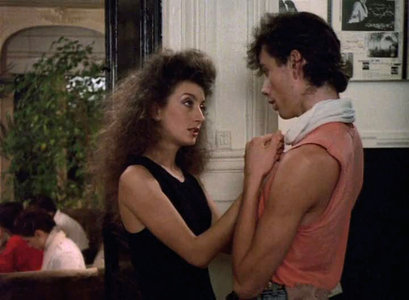
Full Moon in Paris takes it over the top. Not only are we treated to at least three extended sequences of drunk French people boogieing, this film is steeped in the 1980s like no movie I've seen in a long, long time. Pascale Ogier (daughter of Bulle Ogier, from
Celine & Jule Go Boating) plays a young woman who lives in the suburbs with her boyfriend Tchéky Karyo (from
Bad Boys,
GoldenEye and the upcoming
Dobermann II: Arm Wrestle). She's convinces him that it'd be a good idea for her to keep an apartment in the city, where she can spend her Fridays partying with her friends (he prefers to stay home). Karyo's place is all dull modernism, with Mondrians on the walls providing the only small hints of colors that aren't bluish grey, where Ogier's city apartment is a masterpiece of 80s kitsch, she even has fake Greek columns framing her bed. Infidelity is, of course, inevitable. Ogier suspects Karyo when she spies him in town, but decides it was nothing. Later, she hooks up with a fellow she meets at a party who wears cotton gloves with the fingers cut-out, a neck warmer and "plays sax in a band". Feeling guilty, she returns home and finds she had the story wrong all along.
 The Green Ray
 - A pretty, well-meaning, but slightly annoying woman (Marie Rivière, who also played the lead woman in
The Aviator's Wife) can't decide what to do on vacation. Seems the friend she was going to Greece with ditched her at the last minute. She spends some time in the country with another friend's family (freaking them out with her freaky vegetarianism) goes back to Paris and mopes, heads off to the mountains and immediately leaves, and ends up on the coast watching the sunset. It's less verbal than the Moral Tales, which all feature male protagonists who non-stop talk themselves into and out of infidelities. Instead, we get a female protagonist, one who occasionally communicates in conversations, but just as often overhears other conversations, or simply walks alone through the various environments she finds herself in. Nature is more vital here than any of the other Rohmer's I've seen, as it should be given its title, a peculiar and potentially life-changing atmospheric phenomenon. Rohmer is great at endings, and the one here is as beautiful and epiphanic as any in cinema. This remains my favorite Rohmer film, just nudging past
My Night at Maud's.
 My Girlfriend's Boyfriend
 - A Cultural Affairs bureaucrat named Blanche meets a computer student named Lea (played by Sophie Renoir, who had a small role in
The Good Marriage and is the grand niece of director Jean Renoir) for lunch and the two quickly become friends. Blanche lives in a trendy suburban housing complex from which you can almost make out the Eiffel Tower on the horizon. Lea is dating Fabien, though she doesn't really like him that much (he's too earnest for her). Through Lea and Fabien, Blanche meets the handsome and charming Alexandre and instantly falls in lust with him. Unfortunately, he makes her so nervous she can hardly say a word in his presence. When Lea goes on vacation with another man (trying out a break up with Fabien), Blanche and Fabien hang out a lot playing water sports (windsurfing, mostly) and have what they agree is a one-night stand. The ending isn't as uplifting as
The Green Ray (it's less ambiguous) and its Shakespearean dynamics aren't exactly unexpected, but it's the happiest ending of any of the Comedies and Proverbs, a pleasant surprise after the downer that is the Moral Tales closer
Love in the Afternoon.

After watching most of these over the last week, here's how I'd rank them:
1. The Green Ray
2. Pauline at the Beach
3. My Girlfriend's Boyfriend
4. The Aviator's Wife
5. Full Moon Over Paris
6. The Good Marriage
But really, they're all pretty great.